





City Life
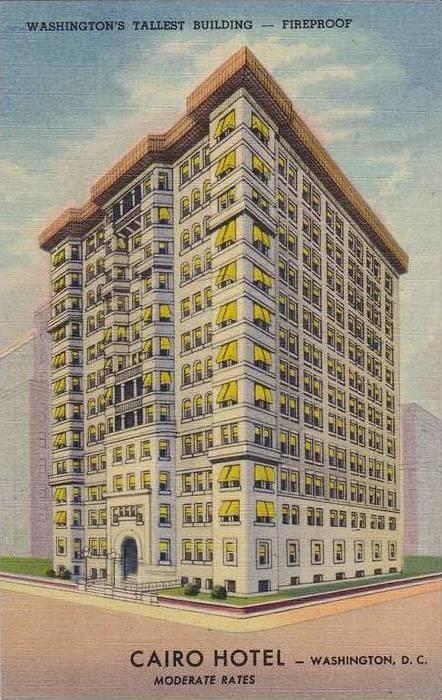
Completed in 1894 as the city’s first skyscraper, the 164ft tall Cairo Flats building prompted local legislation to limit the height of subsequent buildings that continues to shape the District’s skyline. A landmark in the Dupont Circle neighborhood is the Cairo Condominium. It's located at 1615 Q Street, NW, and is the District of Columbia’s tallest residential building. Completed in 1894 as the city’s first skyscraper, the 164ft tall building prompted local legislation to limit the height of subsequent buildings that continues to shape the District’s skyline. Gargoyles and daunting winged creatures hover high above the front entrance, while the stone facade, carved in intricate detail, lends an exotic flavor. Inscribed above its Romanesque Revival arched entrance is the building's name: The Cairo. As charming and unexpected as the Moorish detailing and ghoulish griffins are, it is the Cairo's size relative to its neighbors that is truly its most striking feature.
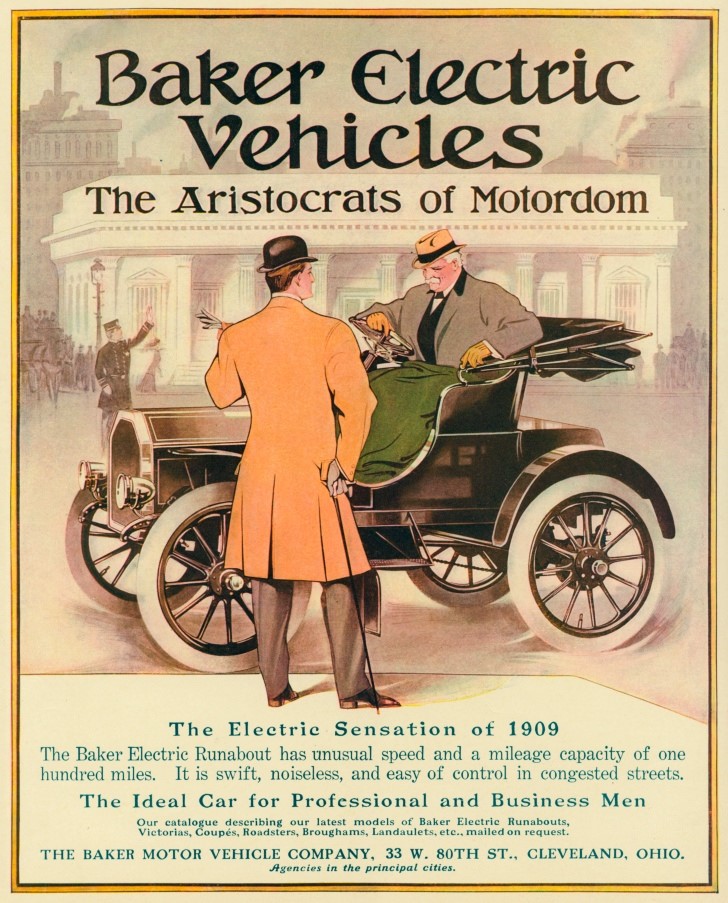
The electric car burst onto the scene in the late 1800s and early 1900s. In 1899 and 1900, electric vehicles outsold all other types of cars. In fact, 28 percent of all 4,192 cars produced in the US in 1900 were electric, according to the American Census. Sales of electric cars peaked in the early 1910s. There were over 300 listed manufacturers who produced a vehicle in the United States upto 1942. Practical electric vehicles appeared during the 1890s. An electric vehicle held the vehicular land speed record until around 1900. In the 20th century, the high cost, low top speed, and short range of battery electric vehicles, compared to internal combustion engine vehicles, led to a worldwide decline in their use as private motor vehicles. Electric vehicles have continued to be used for loading and freight equipment and for public transport – especially rail vehicles.What is likely the first human-carrying electric vehicle with its own power source was tested along a Paris street in April 1881 by French inventor Gustave Trouvé.[20] In 1880 Trouvé improved the efficiency of a small electric motor developed by Siemens (from a design purchased from Johann Kravogl [de] in 1867) and using the recently developed rechargeable battery, fitted it to an English James Starley tricycle, so inventing the world's first electric vehicle.[21] Although this was successfully tested on 19 April 1881 along the Rue Valois in central Paris, he was unable to patent it.[22] Trouvé swiftly adapted his battery-powered motor to marine propulsion; to make it easy to carry his marine conversion to and from his workshop to the nearby River Seine, Trouvé made it portable and removable from the boat, thus inventing the outboard motor. On 26 May 1881, the 5-metre Trouvé boat prototype, called Le Téléphone reached a speed of 3.6 km/h (2.2 mph) going upstream and 9.0 km/h (5.6 mph) downstream.[23] English inventor Thomas Parker, who was responsible for innovations such as electrifying the London Underground, overhead tramways in Liverpool and Birmingham, and the smokeless fuel coalite, built his first electric car in Wolverhampton in 1884, although the only documentation is a photograph from 1895.[24] Parker's long-held interest in the construction of more fuel-efficient vehicles led him to experiment with electric vehicles. He also may have been concerned about the malign effects smoke and pollution were having in London.[25] Production of the car was in the hands of the Elwell-Parker Company, established in 1882 for the construction and sale of electric trams. The company merged with other rivals in 1888 to form the Electric Construction Corporation; this company had a virtual monopoly on the British electric car market in the 1890s. The company manufactured the first electric 'dog cart' in 1896.[26] France and the United Kingdom were the first nations to support the widespread development of electric vehicles.[8] German engineer Andreas Flocken built the first real electric car in 1888.[27][28][29][30] Electric trains were also used to transport coal out of mines, as their motors did not use up precious oxygen. Before the pre-eminence of internal combustion engines, electric automobiles also held many speed and distance records.[31] Among the most notable of these records was the breaking of the 100 km/h (62 mph) speed barrier, by Camille Jenatzy on 29 April 1899 in his 'rocket-shaped' vehicle Jamais Contente, which reached a top speed of 105.88 km/h (65.79 mph). Also notable was Ferdinand Porsche's design and construction of an all-wheel drive electric car, powered by a motor in each hub, which also set several records in the hands of its owner E.W. Hart. The first electric car in the United States was developed in 1890–91 by William Morrison of Des Moines, Iowa; the vehicle was a six-passenger wagon capable of reaching a speed of 23 kilometres per hour (14 mph). It was not until 1895 that consumers began to devote attention to electric vehicles after A.L. Ryker introduced the first electric tricycles to the U.S.[32] Golden age Interest in motor vehicles increased greatly in the late 1890s and early 1900s. Electric battery-powered taxis became available at the end of the 19th century. In London, Walter Bersey designed a fleet of such cabs and introduced them to the streets of London in 1897.[33] They were soon nicknamed "Hummingbirds" due to the idiosyncratic humming noise they made.[34] In the same year in New York City, the Samuel's Electric Carriage and Wagon Company began running 12 electric hansom cabs.[35] The company ran until 1898 with up to 62 cabs operating until it was reformed by its financiers to form the Electric Vehicle Company.[36] Thomas Edison and an electric car in 1913 Electric vehicles had a number of advantages over their early-1900s competitors. They did not have the vibration, smell, and noise associated with gasoline cars. They also did not require gear changes. (While steam-powered cars also had no gear shifting, they suffered from long start-up times of up to 45 minutes on cold mornings.) The cars were also preferred because they did not require a manual effort to start, as did gasoline cars which featured a hand crank to start the engine. Electric cars found popularity among well-heeled customers who used them as city cars, where their limited range proved to be even less of a disadvantage. 1912 Detroit Electric advertisement Acceptance of electric cars was initially hampered by a lack of power infrastructure.[37] In the United States by the turn of the century, 40 percent of automobiles were powered by steam, 38 percent by electricity, and 22 percent by gasoline. A total of 33,842 electric cars were registered in the United States, and the U.S. became the country where electric cars had gained the most acceptance.[38] Most early electric vehicles were massive, ornate carriages designed for the upper-class customers that made them popular. They featured luxurious interiors and were replete with expensive materials. Electric vehicles were often marketed as a women’s luxury car, which may have been a stigma among male consumers.[39] Sales of electric cars peaked in the early 1910s. There were over 300 listed manufacturers who produced a vehicle in the United States upto 1942.[40] At the beginning of the 21st century, interest in electric and alternative fuel vehicles in private motor vehicles increased due to: growing concern over the problems associated with hydrocarbon-fueled vehicles, including damage to the environment caused by their emissions; the sustainability of the current hydrocarbon-based transportation infrastructure; and improvements in electric vehicle technology. Since 2010, combined sales of all-electric cars and utility vans achieved 1 million units delivered globally in September 2016,[1] 4.8 million electric cars in use at the end of 2019,[2] and cumulative sales of light-duty plug-in electric cars reached the 10 million unit milestone by the end of 2020.[3] The global ratio between annual sales of battery electric cars and plug-in hybrids went from 56:44 in 2012 to 74:26 in 2019, and fell to 69:31 in 2020.[3][4][5] As of August 2020, the fully electric Tesla Model 3 is the world's all-time best selling plug-in electric passenger car, with around 645,000 units.[6] Contents 1 Early history 1.1 Electric model cars 1.2 Electric locomotives 2 First full-scale electric cars 3 Golden age 3.1 Power as a service and General Vehicle 4 1920s–1950s 5 1960s–1990s: Revival of interest 6 2000s: Modern highway-capable electric cars 7 2010s 8 2020s 9 Electric bicycle 10 Timeline of milestones 11 Notable production vehicles 12 See also 13 References 14 External links

During the War of 1812, Reuben Daw, a Georgetown merchant, loaned the War Department money to help defend the Capital during the British invasion. Following the War, when the Department was unable to re-pay the loan, Daw and other creditors were offered surplus military gear as payment in kind. Daw wanted to build a fence around his four homes on P and 28 Street. It became a tourist attraction, if not exactly beating swords into ploughshares...
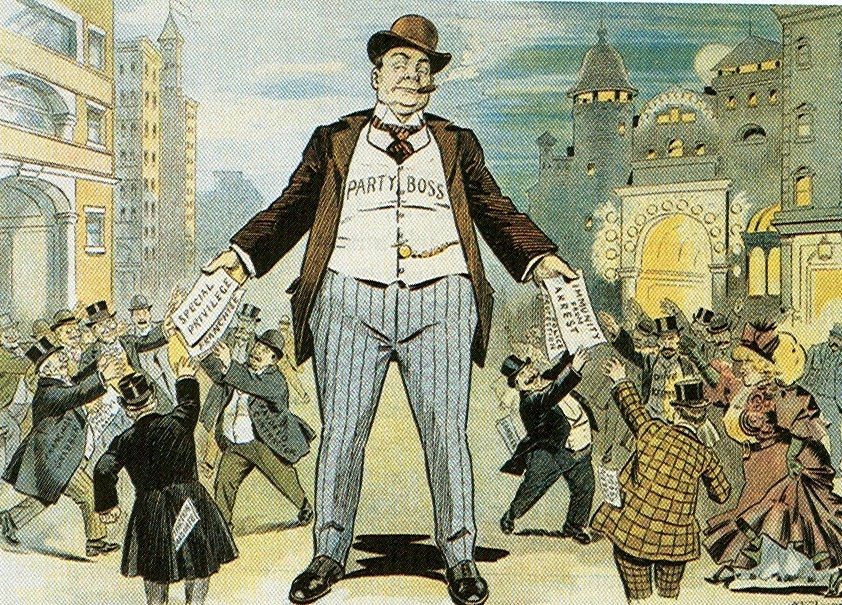
The Gilded Age in America was an era of rapid economic growth, and as wages grew much higher than in Europe, there was a huge influx of immigrants. In one generation a nation of farms, workshops, and small towns had become a society of cities, factories, and intricate social and economic organizations. Until late into the 19th century, newcomers to Washington largely were domestic migrants, particularly Southern blacks. During a time when other cities saw their foreign-born populations skyrocket, Washington’s immigrant population remained comparatively small. In 1900, Washington’s population was only 7 percent foreign-born, compared to Boston’s population of 35 percent foreign-born, New York’s was 37 percent, and Philadelphia’s was 23 percent. (Click)
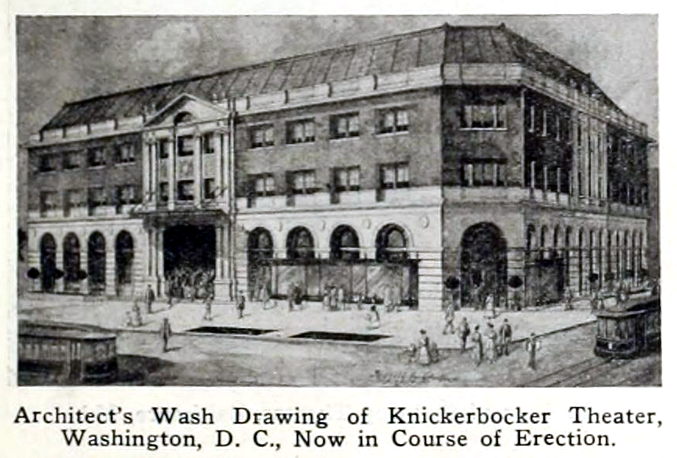
From cinema treasures The Knickerbocker Theatre opened on October 12, 1917, with the historical drama “Betsy Ross” and an appearance by the film’s star, Alice Brady. On January 28, 1922, during an intermission in the hit comedy film, “Get Rich Quick Wallingford”, while the orchestra was playing, the Knickerbocker Theatre’s poorly constructed roof collapsed after a heavy snowstorm over the past two days had piled almost two feet of snow on it. After the cave-in, 98 people were killed and 136 injured, in what was then Washington’s worst disaster. Crandall closed all of his theatres in sympathy for the dead after the Knickerbocker Theatre disaster for a week, and was not charged with any wrongdoing, which was not the case of Reginald W. Geare, whose career as the most popular theatre architect in the District of Columbia up until that time came to an abrupt end. He killed himself in 1927, as did Harry Crandall, who later went bankrupt, a decade later. The Knickerbocker Theatre was a Washington, D.C. movie theater located at 18th Street and Columbia Road in the Adams Morgan neighborhood. It collapsed on January 28, 1922, under the weight of snow from a two-day blizzard that was later dubbed the Knickerbocker Storm. The theater was showing Get-Rich-Quick Wallingford at the time of the collapse, which killed 98 patrons and injured 133. The disaster ranks as one of the worst in Washington, D.C., history. The Knickerbocker Theatre collapse is tied with the Surfside condominium collapse as the third-deadliest structural engineering failure in the United States history, behind the Hyatt Regency walkway collapse and the collapse of the Pemberton Mill. The Knickerbocker Theatre was commissioned by Harry Crandall in 1917. Designed by architect Reginald Geare, it had a seating capacity of 1,700. In addition to serving as a movie theater, it also served as a concert and lecture hall, with ballrooms, luxurious parlors, and lounges.
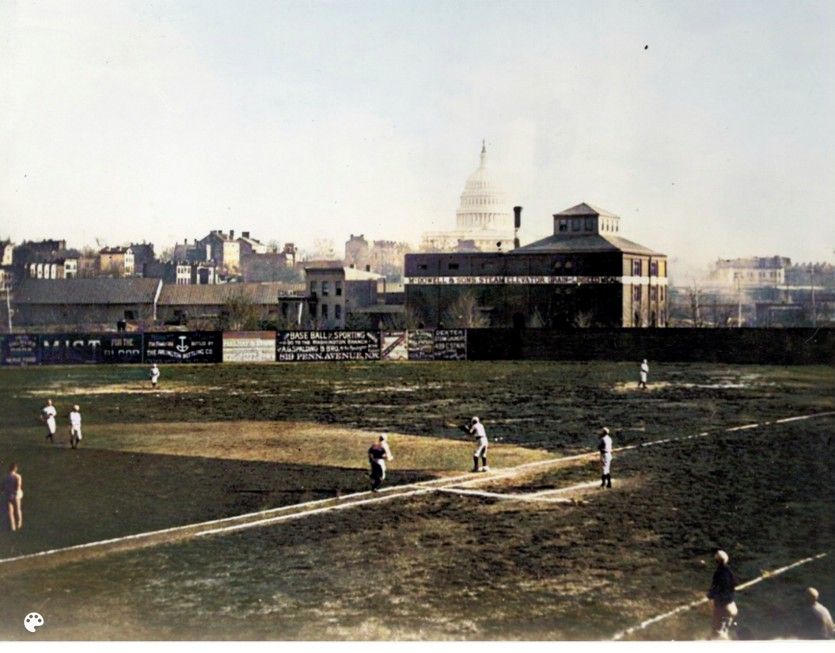
“Swampoodle” was the term originally applied to the settlement along H Street near the Tiber (between North Capitol and First Street, East), and finally it included Pearce’s meadow, a great hunting ground extending to the boundary of the city. … In recent years the eastern line of the ‘poodle’ has been contracted to the limits of G, K, Fourth, East, and First Streets, West. . . .” The name was applied in the 1850s, although when exactly is unknown. Swampoodle was a neighborhood in Washington, D.C. on the border of Northwest and Northeast in the second half of 19th and early 20th century. This neighborhood is no longer known as Swampoodle and has been replaced in large part by NoMa.


